


Building a stronger educator workforce requires more than bringing new teachers into classrooms. It requires creating pathways into the profession, removing barriers to certification, and ensuring educators have the support and community they need to flourish.
That work is central to The Educator Academy, one of our partners in the Teach KC Collaborative. Founded in 2015 as the Kansas City Teacher Residency, the organization prepares and supports educators across the Kansas City metropolitan area, helping aspiring teachers enter the profession and grow into effective classroom leaders.
Through Teach KC, BLAQUE Kansas City and our eight partners are working to recruit, train, place, and retain 1,500 new teachers across our region over the next decade. The Educator Academy brings a decade of experience to that shared effort and a belief that investing in educators creates greater opportunities for students and communities.
We sat down with Charles King, Founder, President, and CEO of The Educator Academy, to discuss his journey into education, what teachers need to thrive, and why he believes this collaboration can help transform the future of teaching in Kansas City.
This interview has been edited for length and clarity.
BLAQUE Kansas City: For readers who may not know you yet, can you share a bit about your background and what ultimately led you to establish The Educator Academy?
Charles King: I was born in New Jersey, grew up in Connecticut, and had the incredible opportunity to attend Morehouse College. I studied political science and thought I would become an attorney. That was the plan—but it wasn’t the journey.
After graduating, I entered teaching through Teach For America. This is my 24th year in education. I started in the Houston Independent School District, later taught in a charter school network, and eventually became a principal.
What drew me to education was the experience I had with my own teachers and professors. They saw me for who I was, believed in me when I didn’t believe in myself, and pushed me to become better. That still shapes how I think about this work. As educators, we are here to challenge, support, nurture, and develop the students in front of us.
As a principal, one of our biggest challenges was finding and keeping great teachers. During my last two years in that role, we partnered with a teacher residency program. What stood out was how deeply its participants were rooted in the community. They reflected our students and brought a strong commitment to the work.
That experience sparked my interest in the residency model.
Around that time, the Kauffman Foundation was exploring ways to respond to Kansas City school leaders’ concerns about the educator pipeline. They identified the residency model as a promising approach and selected me to lead the effort.
In 2015, we launched what was then the Kansas City Teacher Residency. The question was: How do we bring school districts, our organization, and philanthropy together to build a meaningful teacher preparation and retention pathway for Kansas City?
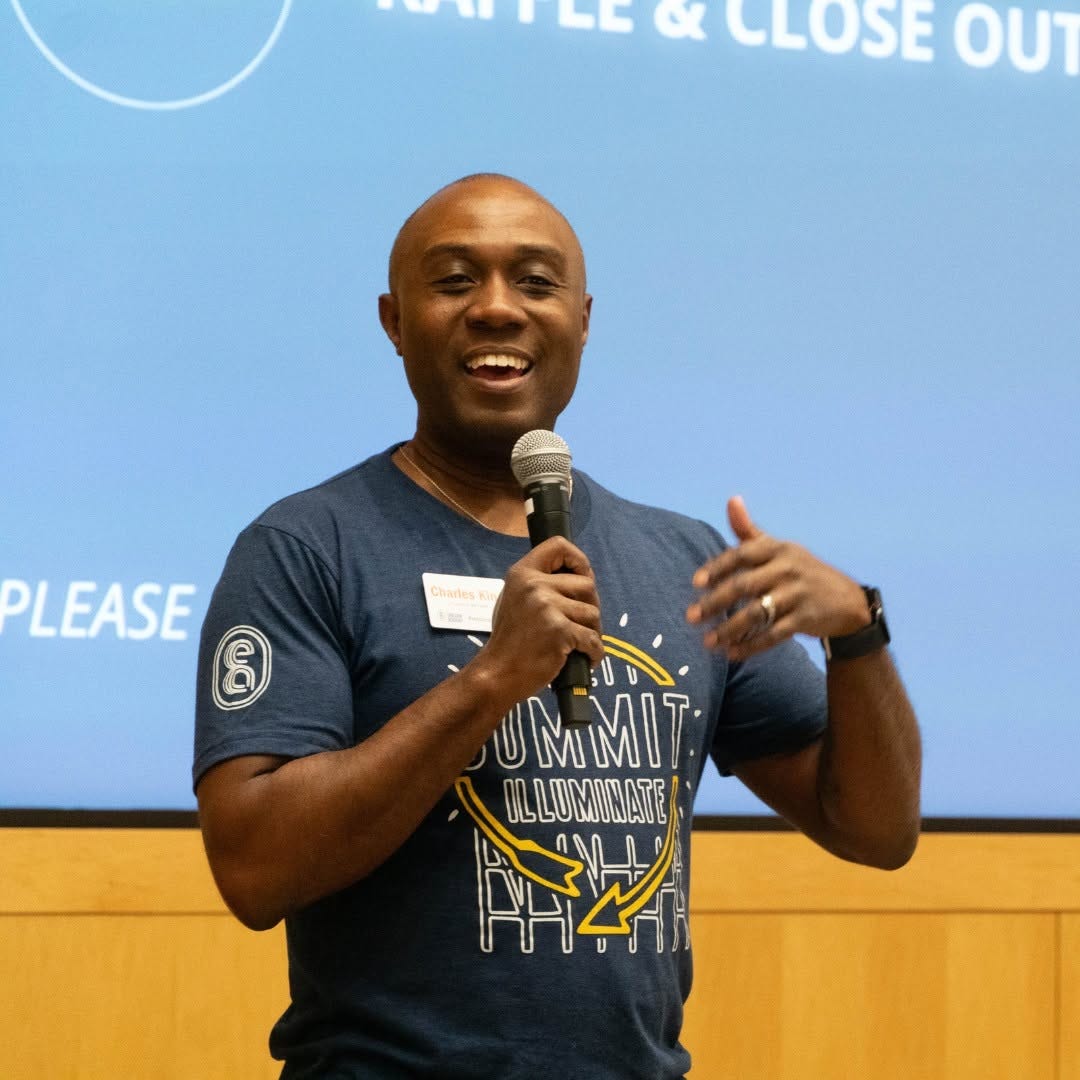
BLAQUE Kansas City: What are you seeing in today’s education landscape that makes Teach KC especially important right now?
Charles King: Across Missouri and Kansas, schools are facing teacher vacancies. Some classrooms rely on substitutes, while others are staffed by individuals teaching without certification or outside their certification area.
We are also seeing too many people leave education for a range of reasons, including financial pressures. Schools with the greatest needs are often the most affected by vacancies and teacher turnover.
The challenge is real, and addressing it will take a whole-community approach.
Historically, we have often worked in silos. There has been collaboration, but what we need now is something bigger and bolder. Teach KC creates an opportunity to approach this challenge together in a different way.
BLAQUE Kansas City: Through your work with The Educator Academy, what have you learned about what aspiring and early-career educators need to enter the classroom and build lasting careers?
Charles King: They need support—but support means a lot of different things.
It starts when someone applies. We need to help them navigate recruitment and selection, place them in an environment where they can succeed, and support them throughout that journey.
If they struggle in their coursework, we need structures that help them get back on track. They need opportunities to practice, try again, and improve.
Their preparation also has to reflect the context in which they will teach. When educators learn a skill, they need to understand what it means for the students in their classrooms. Making that connection helps their learning stick and allows them to experience success early.
Once they begin teaching, they need someone to turn to—a coach or a program that can help them work through questions and challenges.
We also have to address the barriers to certification. Exams can be difficult and expensive. Someone may need tutoring, financial assistance, or the ability to retake a test. Without that support, a certification hurdle can become something that prevents a talented educator from continuing in the profession.
At The Educator Academy, we focus on helping people feel prepared for the classroom, get through certification, and find success during their first three years of teaching.
We want them to be able to focus on becoming great teachers.
From there, we also see opportunities for growth. Our graduates have become assistant principals, instructional coaches, and district leaders. Others remain in the classroom and continue doing exceptional work for students. We want to support both paths.

BLAQUE Kansas City: What has given you confidence in BLAQUE Kansas City’s vision and approach, and why do you believe the organization is positioned to help lead this work alongside its partners?
Charles King: It starts with Dr. Hill’s bold vision and leadership.
Through the Charter School Board Draft and its work around governance, BLAQUE Kansas City has helped position Black and Brown community members to serve on school boards and influence education in meaningful ways.
Its work has also demonstrated a commitment to thinking about the schools we need to build so that all students can succeed, with particular attention to Black and Latinx students.
When Dr. Hill first called me to discuss the Teach KC vision, the connection was clear. If we are supporting schools and school leaders, we also need teacher talent and strong partnerships that can help build that pipeline.
BLAQUE Kansas City brings a broader view of the education ecosystem. It sees the connections across the work and brings people together to solve problems.
What I appreciate most is the collaborative approach. The team asks how we can uplift the genius of the group. It doesn’t come into the room assuming it has every answer or telling partners what to do.
That approach has built trust among the organizations involved. It has helped us consider ways of working together that we might not have pursued on our own.
I also believe there will be accountability with support. BLAQUE Kansas City is invested in the success of each partner organization, and that matters when you are building a collaboration like this.
BLAQUE Kansas City: Looking ahead, what gives you the most hope about what Teach KC can make possible?
Charles King: The organizations at the table have already demonstrated success in their individual work. When we bring that collective genius together, we can do more and do better.
I believe it can be transformative. We have an opportunity to accomplish things bigger than any of us could have imagined individually.
For students, I want amazing educators in front of them—teachers, assistant principals, and principals who deeply believe in them and are passionate about their success.
I want those educators to inspire students to see beyond the limitations they may place on themselves and imagine what is possible.
I also want us to change the way we talk about student achievement. Instead of approaching literacy and numeracy in Kansas City’s urban core through a deficit lens, I want us to be talking about how students are exceeding expectations.
For educators, I want an environment where they feel valued, appreciated, and invested in.
I want them to feel that the community sees them as a critical anchor. That might mean growing into school or district leadership. It might mean purchasing a home and living in the same community as their students.
We want educators to have deep roots and a strong community around them.

BLAQUE Kansas City: If Teach KC succeeds over the next five to ten years, what do you hope will be different for Kansas City students, educators, and communities?
Charles King: I hope we see fewer students falling behind and more students graduating from high school with opportunities in front of them that they can choose for themselves.
I hope students have access to educators who know their content and have the skills to help them grow and succeed.
For educators, I hope we close the vacancy gap and reduce teacher turnover, especially among educators of color. We need to address the places where people are falling out of the pipeline so they can stay and find success in Kansas City schools.
For the broader community, I hope we see deeper collaboration and greater continuity across our education system.
I believe we can help reimagine what K–12 education looks like across the metro in a way that is more unified and aligned—where businesses and community members are invested, and everyone recognizes that all students deserve an excellent, quality education.
This coalition is positioned to do something big and bold. If we can accomplish that together over the next five to ten years, that would be success.
A teacher buying a home in the same community as their students is the picture from this that stayed with me. Was there a teacher who showed you what that kind of anchor looks like?